What Is Morse Code? A Complete Beginner's Guide
What is Morse code? Learn the meaning, definition, dots and dashes, timing rules, history, and modern uses of Morse code in this complete beginner's guide.
Morse code is a method of encoding text as a series of on/off tones, lights, or clicks. You can push it across telegraph wires, beam it over radio, blink it from a flashlight, or tap it on a wall. If you want a one-sentence morse code definition, here it is: a system of dots (.) and dashes (-), spoken aloud as dit and dah, that stand in for the letters of the alphabet, the digits, and a handful of punctuation. The morse code meaning has barely shifted in 180 years. It is still the most efficient way humans have invented to push text through a single on/off signal.
This guide unpacks what the code actually is, how the symbols work, the timing rules that hold the whole thing together, a brief history, and the places where it is still in active use. By the end you should be able to read short words by ear and experiment with the text to Morse code converter.
What Is Morse Code? A Plain-English Definition
Strip away the historical romance and Morse code is a binary signaling system. There are only two states, on and off, and the length of each on and off period is what carries information. A short on pulse is a dot (also called a dit). A long on pulse, roughly three times longer, is a dash (a dah). Combinations of dots and dashes map to letters, digits, and symbols.
For example:
.-= A-...= B... --- ...= SOS
That last one is famous for a reason. It is an internationally recognized distress signal: three dots, three dashes, three dots, sent as a single unbroken prosign.
One thing easy to miss: the system is language-agnostic. Each Latin letter maps to a unique dot-dash pattern, so the same code can spell English, Spanish, French, or any text that uses the Latin alphabet. It is also medium-agnostic. The same ... --- ... works as a radio tone, a blinking flashlight, a tapping finger, or a puff of smoke against a cold sky.
Dots and Dashes: Dits and Dahs
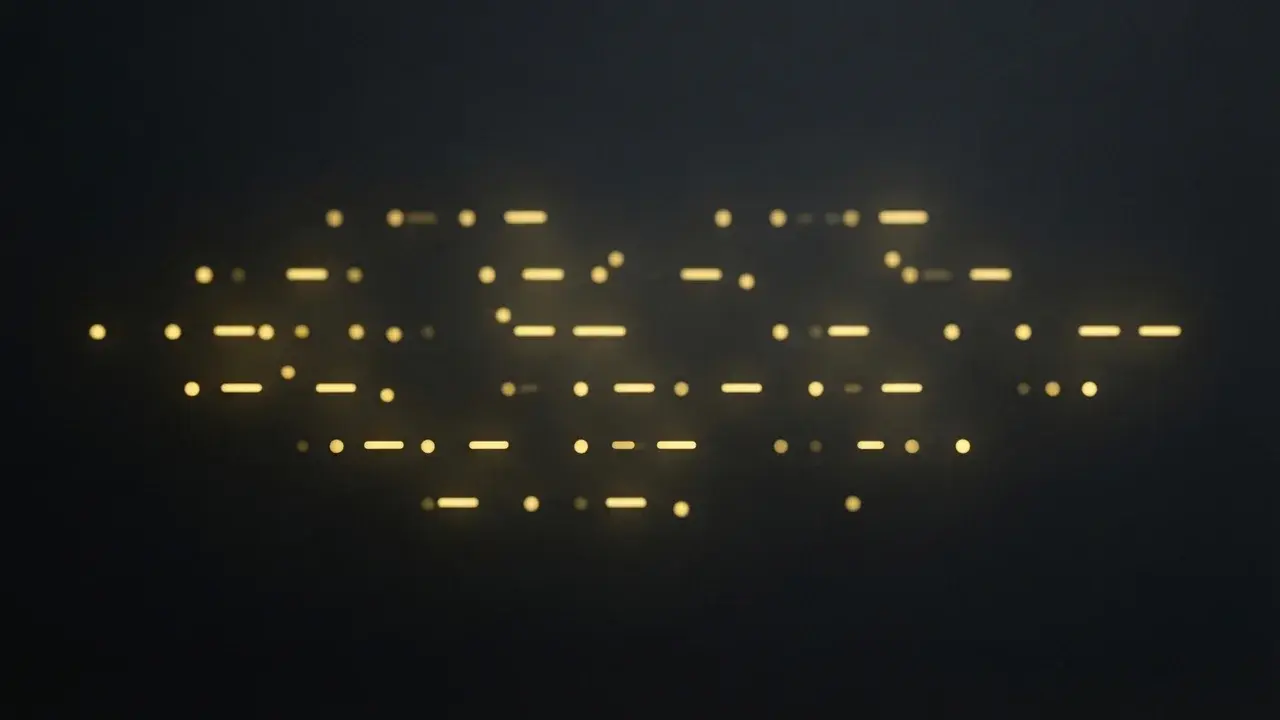
Operators almost never say "dot" and "dash" out loud. They pronounce each symbol by its sound:
- Dot = dit (short, sharp)
- Dash = dah (long, drawn out, about three times longer than a dit)
So the word "cat", written -.-. .- -, is spoken aloud as dah-dit-dah-dit dah-dit dah. Once you read code by ear for a while, the rhythm of dits and dahs stops feeling like symbols and starts feeling like words. Skilled operators stop consciously decoding somewhere around 18 to 20 WPM and just hear the letters arrive.
That sound-first approach is worth pausing on. Morse's original 1840s equipment embossed marks onto paper tape for visual reading. Within a few years, operators discovered that listening to the sounder's click was far faster, and reading by ear became the norm. That is also why modern learning methods like the Koch method train your ear from day one rather than asking you to memorize a chart.
The Five Timing Rules That Define Morse Code
Morse code is not just dots and dashes thrown together. The silences between them carry just as much information as the sounds. The entire system rests on five timing rules, all measured in a base unit called the dit length:
- A dit is 1 unit of time.
- A dah is 3 units (three times the dit length).
- Intra-character gap, the silence between dits and dahs within a single letter, is 1 unit.
- Inter-character gap, the silence between letters in a word, is 3 units.
- Word gap, the silence between words, is 7 units.
These rules exist for a reason. They let a listener distinguish a single long dash from three short letters separated by gaps. Without the silence rules, - - - could be three T's (- - -) or a single O (---). The timing is the grammar.
A common beginner mistake is to focus on the dits and dahs and ignore the gaps. The result sounds choppy and ambiguous. Get the silences right and the code becomes legible even through heavy static.
For the full rule-by-rule breakdown, the PARIS calibration word, and how timing translates to WPM, see our complete Morse code timing rules guide. For the underlying binary system and how letters are formed, see how does Morse code work.
A Brief History of Morse Code
Morse code was born in the 1830s and 1840s alongside the electromagnetic telegraph. The conventional story credits the American painter Samuel F. B. Morse, but the truth is more interesting, and more collaborative. Morse's partner Alfred Vail and Vail's assistant are widely believed to have done much of the actual code design, including the famous letter-frequency optimization that gives the most common letters (E, T) the shortest symbols.
Key milestones:
- 1832 — Morse conceives of a single-wire telegraph while returning from Europe by ship.
- 1837–1838 — Morse and Vail demonstrate a working system and an early code.
- 1844 — Morse sends "What hath God wrought" from Washington to Baltimore.
- 1865 — The International Telegraph Union standardizes a slightly modified "Continental" code, now called Morse code standard (the version used worldwide today).
- 1912 — After the Titanic disaster, SOS (
... --- ...) becomes the global maritime distress call. - 1999 — Maritime Morse is officially retired in favor of GMDSS satellite systems, but amateur radio keeps the code alive.
You can read the full timeline in our history of Morse code, or dig into the inventor controversy in who invented Morse code.
The Basic Morse Code Alphabet
Here is the full A–Z alphabet in International Morse Code. For letters, numbers, punctuation, and prosigns, see the complete Morse code alphabet chart.
| Letter | Morse | Letter | Morse | Letter | Morse |
|---|---|---|---|---|---|
| A | .- | J | .--- | S | ... |
| B | -... | K | -.- | T | - |
| C | -.-. | L | .-.. | U | ..- |
| D | -.. | M | -- | V | ...- |
| E | . | N | -. | W | .-- |
| F | ..-. | O | --- | X | -..- |
| G | --. | P | .--. | Y | -.-- |
| H | .... | Q | --.- | Z | --.. |
| I | .. | R | .-. |
A few patterns are worth noticing.
The most common letters in English, E (.) and T (-), have the shortest possible codes, a single symbol each. The next most common, A, I, N, M, all get two-symbol codes. That is not an accident. It was a deliberate design to minimize total transmission time on slow telegraph lines. Numerals all use exactly five symbols, making them easy to recognize in noisy conditions. Punctuation marks use six or more symbols because they are rare and benefit from being unambiguous.
A caveat worth mentioning: that famous letter-frequency optimization was tuned for English. If you send Spanish or French text where letter frequencies differ, the code becomes less efficient. It still works perfectly, just not quite as economically.
Modern Uses of Morse Code
Morse code is far from dead. It is no longer required for maritime use or for most amateur radio licenses, but it remains in active use across at least ten distinct domains: amateur (ham) radio as CW, accessibility switch-input for users with motor impairments, emergency SOS signaling, aviation navigational beacons (NDBs), maker projects, escape rooms, military SERE training, scouting education, art and music, and as a hobby in its own right.
That said, Morse is not a magic universal fallback. It is slow compared to text messaging. It requires trained operators on both ends. And modern digital modes like FT8 often outperform it for raw throughput on weak signals. Where Morse still shines is in conditions where almost nothing else works: very low power, very poor signal-to-noise, or extremely simple hardware that needs to last for years on a battery.
Each of those modern applications deserves its own coverage. For the full list with examples, history, and how to get involved in each area, see our dedicated is Morse code still used today? guide. Want to try sending some yourself? Paste text into the online Morse code tool and listen to it as audio.
Frequently Asked Questions
Is Morse code still used today?
Yes. It is still actively used by amateur radio operators, in aviation navigational beacons, as an accessibility input method, and in emergency signaling. Maritime use officially ended in 1999, but the code itself is far from obsolete.
Is Morse code hard to learn?
The basics (recognizing the alphabet at 5 WPM) take most people 2 to 4 weeks of daily 15-minute practice. Reaching 20+ WPM takes longer, typically 3 to 6 months, because you have to transition from "decoding symbols" to "hearing whole words." See our honest timeline in how long to learn Morse code.
What does SOS actually mean?
Nothing. SOS (... --- ...) was chosen because it is a single unbroken prosign, easy to send, easy to recognize in noise, and unambiguous. It does not stand for "Save Our Souls" or "Save Our Ship," although those are popular backronyms.
What's the difference between a dot and a dash?
A dot (dit) is the basic 1-unit pulse. A dash (dah) is a 3-unit pulse, three times longer. The ratio is always 1:3 regardless of sending speed. Faster operators send shorter dits, but the 1:3 ratio stays the same.
Do I need to learn Morse code to use a ham radio?
In most countries, no. Morse code was dropped as a licensing requirement in the early 2000s. But many hams learn it anyway because CW (Morse) is one of the most reliable long-distance modes, and there is a deep culture and tradition around it.
Found this article helpful? Share it with others who might enjoy it.
Try it in the Translator
Put what you just read into practice — open the inMorse translator and start sending real Morse code in seconds.